



The importance of structure
For the past decade, investors have become increasingly focused on returns, and social media has certainly accelerated the trend. Every day brings another Instagram reel or TikTok explaining how you can beat the market, select winning shares or outperform a benchmark. Yet there is a curious irony: you may spend years trying to earn an additional 1% of annual return, while paying far less attention to the structural decisions that ultimately determine how much of your wealth reaches your family. The question is not only “What return am I earning?” It is also “What happens to my money after I am gone?” Taxes, estate administration, executor costs and asset structure can have a profound influence on what your family ultimately receives. In some cases, these factors may matter more than modest differences in investment performance.
To illustrate the point, imagine that you have R10 million of financial assets and are considering how that wealth may one day pass to your family. The investment outcome during your lifetime is only part of the story. The structure in which your money is held can affect the amount that is available to your beneficiaries, the speed with which they receive it and the capital they have available to continue their own wealth journey. The following assumptions are used for illustration only:
- In both scenarios you pass away with R10 million.
- Both portfolios are assumed to achieve the same return.
- Estate abatements are assumed to have been used elsewhere.
- The illustration uses simplified tax and cost assumptions.
The purpose of this example is not to suggest that every client should use the same structure.
It is to show that two portfolios with the same market value can produce very different family outcomes depending on how the assets are held, taxed and transferred.
In the first scenario (Scenario A), your R10 million is held entirely in unit trusts and shares, with no specific estate structuring applied.
| Unit Trust and Share Portfolio | R10m | Included in estate; CGT and executor fee assumed. |
In the second scenario (Scenario B), the same R10 million is held across different investment structures, each with different estate, tax and beneficiary consequences.
| Living annuity value | R4m | Excluded from deceased estate; assumed to continue to nominated beneficiaries. |
| Sinking fund value | R4m | Ownership rolls over; no CGT crystallisation or executor fee; included for estate duty. |
| Unit trust value | R1.5m | Included in estate; CGT and executor fee assumed. |
| Cash value | R500k | Included in estate; executor fee assumed. |
Now assume you pass away. The question is no longer what your portfolio was worth on the date of death, but how much capital your family receives after tax, estate costs, administration and structure have all taken effect.
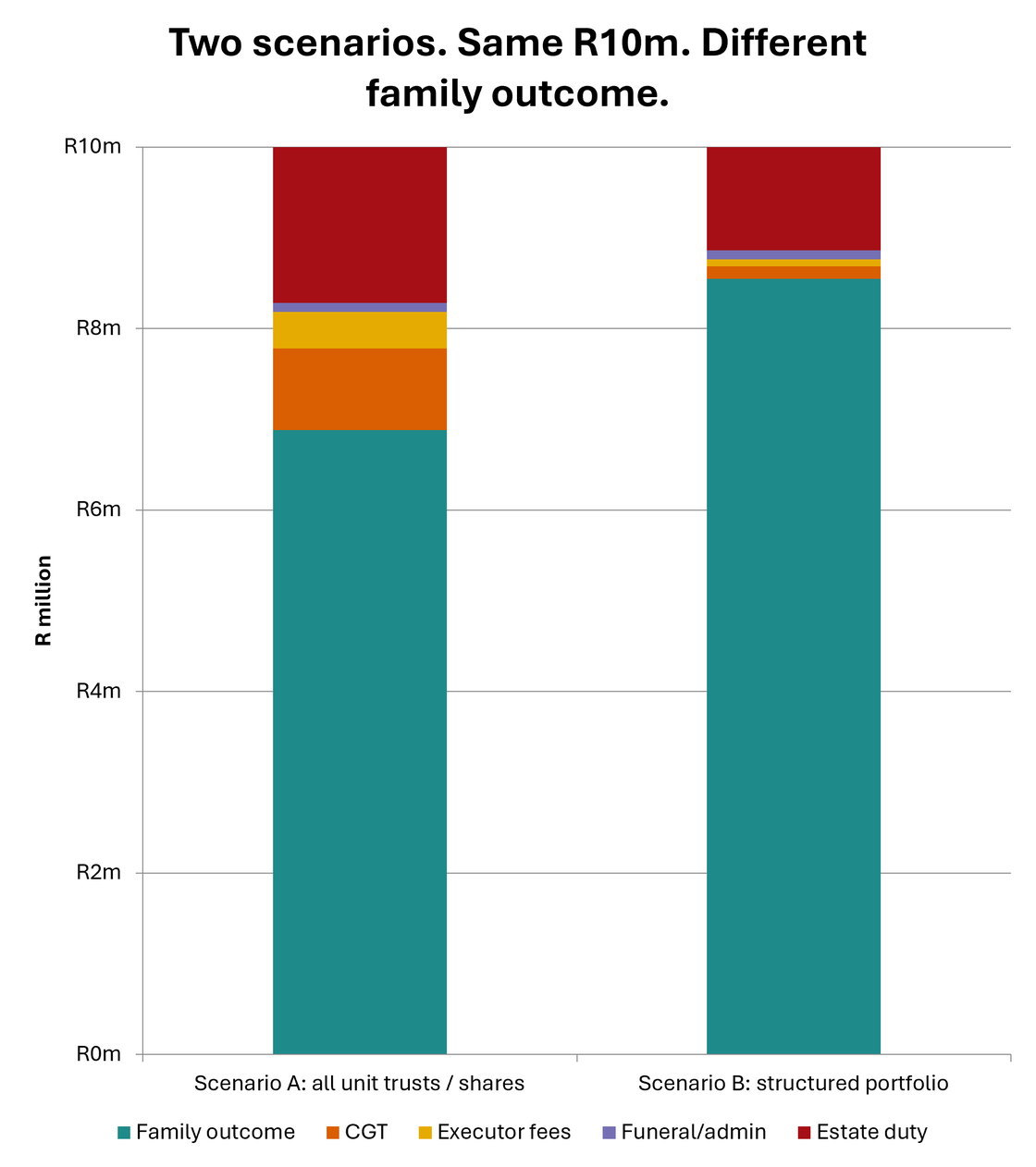
| Scenario A | Scenario B | |
|---|---|---|
| Starting wealth | R 10 000 000 | R 10 000 000 |
| CGT | (R 900 000) | (R 135 000) |
| Executor fees | (R 402 500) | (R 80 500) |
| Funeral/admin | (R 100 000) | (R 100 000) |
| Estate duty | (R 1 719 500) | (R 1 136 900) |
| Family outcome | R 6 878 000 | R 8 547 600 |
This is the point at which the differences become visible. The two scenarios are not different in any meaningful economic sense. They have taken the same investment risk and achieved the same investment return. The difference emerges only when that wealth moves from one generation to the next. The graph above illustrates the impact of taxes, executor fees, estate administration costs and asset structure on that transfer. In the unstructured scenario, the family receives approximately R6.88 million. In the structured scenario, the family receives approximately R8.55 million – a difference of approximately R1.67 million.
A R1.67 million difference may not seem like a slam dunk in the context of a R10 million estate, but this is where the story becomes more important. The transfer of wealth is not the end of the investment journey; it is the beginning of a new one for the people who inherit it. Your children and/or beneficiaries will make their own investment decisions, build their own financial plans and continue their own wealth creation journey. The amount of capital they start with matters enormously. The next chart assumes that both families invest their inheritance for a further 20 years and achieve the same annual return of 10%. There is no superior investment manager, no better market timing and no additional risk – just the same return applied to different starting amounts.
That is where a R1.67 million difference becomes an R11.2 million difference.
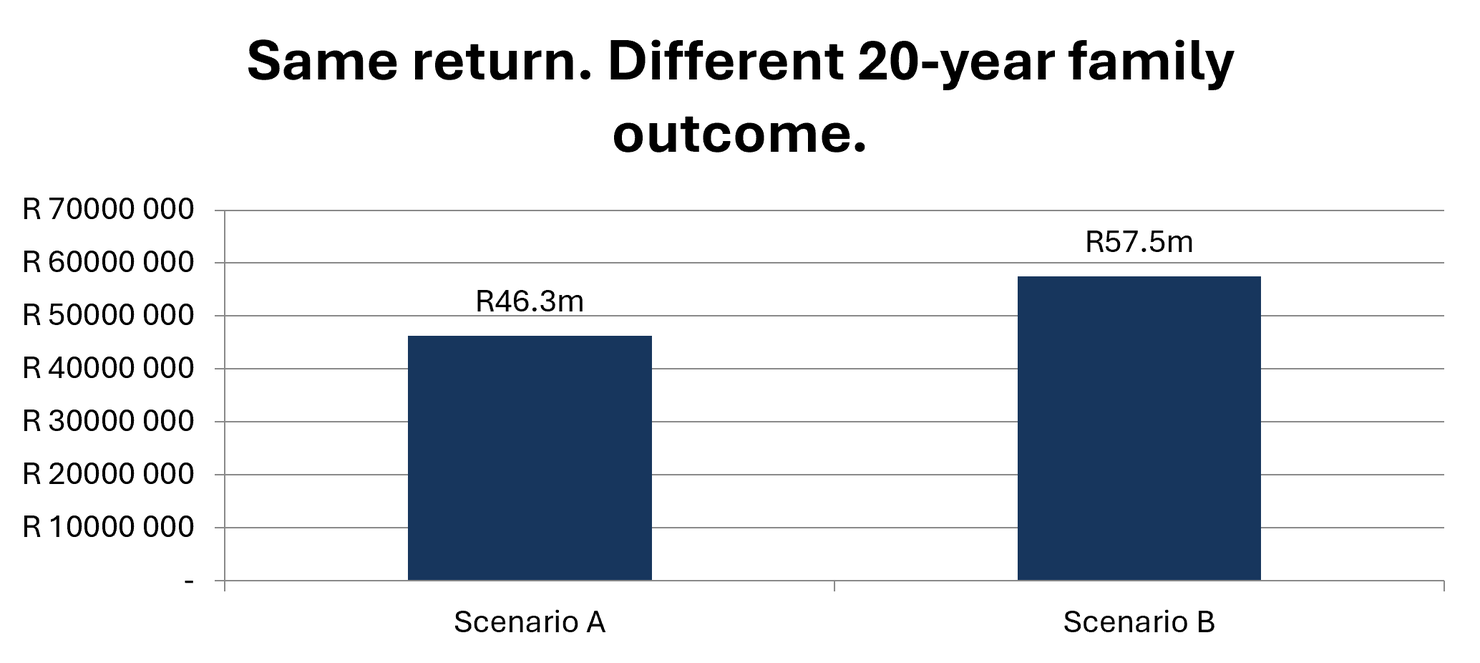
Many investors spend their lives searching for an additional 1% of annual return. This modelling suggests that broad structuring can have an effect equivalent to approximately 1.2% per annum over the next generation’s investment lifetime. For you, the lesson is not that returns are unimportant. It is that the structure around your investments can be just as important as the investments themselves. Estate planning should not be viewed merely as a tax exercise. It is a capital preservation tool. Every additional rand that reaches your family is a rand that can participate in future compounding.
Estate administration can also delay the point at which beneficiaries gain control of inherited capital. Although estate assets may remain invested during this period, beneficiaries may be unable to restructure or deploy them in accordance with their own financial plans. Delay therefore creates an additional, less visible cost: lost flexibility and the possibility that capital is not invested as appropriately as it otherwise might have been.
The purpose of this comparison is not to suggest that one structure is better than another. Every investment structure involves trade-offs, with its own advantages, disadvantages, costs, tax consequences and planning implications. The lesson is simply that the way wealth is held can materially influence the amount ultimately received by the next generation.
In this example, Investor A would have needed to earn approximately 11.2% per annum for the next 20 years merely to place their family in the same position as Investor B’s family starting with a larger inheritance.
Social media has made investment returns the headline act of personal finance. Returns are certainly important, but they are not the whole story. The investment industry spends a great deal of time discussing how you can build wealth and far less time discussing how that wealth will ultimately be transferred. That distinction matters. After all, your family does not inherit your portfolio statement. They inherit what remains after structure, tax, administration and time have all taken their share.
As an investor, the question is not simply how much wealth you can accumulate. It is whether that wealth is structured in a way that gives your family the best possible chance of receiving, preserving and compounding what you intended for them. Ultimately, your family doesn’t inherit your portfolio. They inherit what remains.
Regulatory Disclaimer
Important notice
This article is provided for information purposes only and does not constitute financial, tax, legal, estate planning or investment advice. The structures referenced in this article are discussed solely for illustrative purposes. Every investment structure has advantages, disadvantages and potential opportunity costs. The suitability of any strategy depends on an individual’s objectives, circumstances, tax position, liquidity requirements and estate planning considerations. Investors should consult their financial adviser, tax practitioner and legal adviser before implementing any strategy discussed in this article. The examples contained herein are hypothetical and should not be relied upon as a basis for investment or financial planning decisions.
Graph assumptions
Unless otherwise stated, all illustrations assume a 10% annual investment return and are intended solely to demonstrate the potential impact of structure on long-term outcomes.
Assumptions:
- Consider only financial assets.
- Exclude property, business interests and personal assets.
- Assume estate duty exemptions and abatements have been utilised elsewhere in the estate.
- Assume executor remuneration of 3.5% plus VAT.
- Use simplified tax assumptions for illustrative purposes.
- Do not represent the actual tax position of any individual investor.