


Without risk, there is no reward
Understanding risk, capacity, and tolerance is key to building portfolios that balance volatility with long-term growth.


Ensuring our clients take suitable amounts of risk is a cornerstone of financial planning, directly impacting our client’s ability to achieve life goals across various life stages. This involves a deep understanding of what risk truly means in an investment context and how asset allocation aligns with a client's unique profile.
From an investment planning perspective, risk is defined as the possibility of capital loss in nominal terms, real terms, and/or the possibility of not achieving a client’s investment objectives over an agreed investment term. This goes beyond mere "paper losses" or temporary drops in portfolio value to encompass permanent capital loss and the critical risk of not preserving purchasing power against inflation over time. For instance,
investing money that fails to keep pace with inflation ultimately means a loss in future purchasing power.
Risk profile should be understood as the risks an investor needs to take to achieve their objectives, given their ability and willingness to accept those risks.
Risk profile comprises three key components:
- Risk Required: This is the level of risk associated with the investment return necessary to achieve the client's agreed needs and objectives over a specified investment term, considering their available financial resources. For example, funding a child's education in five years versus saving for retirement in twenty years will likely require different levels of risk. Determining this involves a cash flow analysis and projecting the required investment return, taking into account factors like current savings, additional contributions, and inflation. The outcome of this analysis quantifies the risk that must be taken.
- Risk Capacity: This refers to the client's ability to withstand a decline in the value of their investments without a materially detrimental effect on their standard of living. It is about having sufficient financial resources, such as an emergency fund, alternative income sources, or highly liquid investments, that can "buy enough time" for investments to recover during market downturns. Risk capacity is particularly vital for clients in or nearing retirement, as liquidating declining portfolios can have severe long-term consequences on their income sustainability.
- Risk Tolerance: This is the client's willingness to expose their capital to potential losses over the selected investment term. It is a psychological trait that can often lead to emotional decisions when markets fluctuate. Therefore, it is critical to ensure that clients understand and are willing to accept these potential risks.
Once the "risk required" to meet the client's objectives has been quantified, a suitable asset allocation can be determined. This involves selecting the appropriate combination of asset classes (e.g. equities, bonds, cash) that offers the highest probability of achieving the required return, while clearly disclosing the associated risks over both short and long terms.
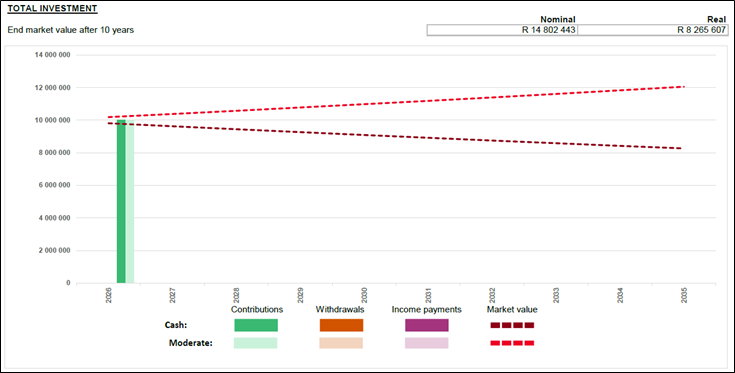
For an example of this concept, see the below difference between different risk profile / asset allocation comparing a cash scenario vs a moderate risk investment:
Moderate Investment (Red Line):
- Net return rate: 8%
- For a moderate client’s portfolio and risk profile we would aim for CPI+4%. With the invested strategy, we change the tax profile of the funds from pure interest (which would attract a tax rate of 45% as per the below cash scenario) to a combination of interest and capital gains, as well as using structures such as endowments to significantly reduce the overall tax rate on the return. For the purposes of the projections, we estimate an average tax rate of 20%. For the projection we have used a net return rate of 8%.
Cash Portfolio (Purple line):
- Net return rate: 4%
- We have used an 8% gross return rate from cash. We take tax into account at 45% of the interest earned and given that interest rates are forecast to decline over the coming years, we have used a net return rate of 4%.
Taking R10 million as the initial investment, we can see that over the 10-year period the cash strategy, after taking tax into consideration, is not an effective investment strategy and will not keep up with inflation (6% used for the below projection) with capital slowly eroded over time. In real terms (after inflation is taken into consideration), the moderate portfolio is projected to outperform the cash strategy by R3 789 717.
With risk, there is market volatility, which is the inherent fluctuation in asset values, characterised by their possibility to rise and fall. This volatility is, in essence, the price we pay for returns.
Volatility is important because it is the engine that drives long-term equity returns. It creates the risk that investors get paid for, the opportunities to buy undervalued assets, and the compounding effect that builds wealth.
Without volatility, stock investing would be no more rewarding than holding cash. Therefore, embracing the discomfort of market volatility is often necessary to achieve investment objectives, particularly in ensuring that capital growth outpaces inflation over the long term. This understanding is critical, as volatility can often lead to emotional decisions and panic selling at the wrong time, potentially derailing long-term wealth creation.
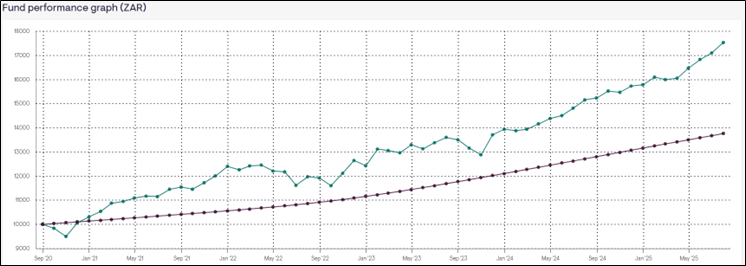
To illustrate this relationship between risk and reward, the image below shows a comparison between a moderate investment fund and a money market fund over a 5-year period. The money market fund (purple line) shows a much smoother, less volatile progression, reflecting its lower risk profile. In stark contrast, the moderate fund (green line) clearly demonstrates market volatility, with the up-and-down movement in asset values, but ultimately outperforms the money market fund.
Sound advice requires an understanding of a client’s objectives, life stage, personal and financial circumstances to balance these three risk components effectively. It is important to take necessary and suitable risks to achieve a client's long-term objectives, even if it entails short-term volatility or discomfort.
Don't forget to share this post!
Back to topRelated #Knowledge



Copyright © 2020 | All rights reserved.
NFB Private Wealth Management, NFB Asset Management and
NFB Insurance Brokers (Border) are authorised financial services providers.
NFB Finance is a registered credit provider (NCRCP16390).
PAIA | Privacy | Complaints Policy | Disclaimer
Click here to blow the whistle
Conflict of Interest Policies:
NFB Private Wealth Management,
NFB Asset Management
NFB Insurance Brokers
Complaints Handling Policy:
NFB Asset Management